

Buying Lederhosen: Leather Types, Quality & Fit at a Glance
|
Time to read 9 min

|
Time to read 9 min
A women's Lederhose is not a throwaway item. Invest in a good pair once and you will wear it for ten, twenty or even thirty years. That is exactly why it pays to look closely when you buy: which leather, which cut, which quality. This guide explains everything you need to know before you buy a Lederhose.
Why you can trust us:
✓ We follow the latest Tracht trends and know the newest collections
Want to find out more? Visit our store
Table of Contents:
Before you think about leather type and quality, there is one basic question: short or knee-length? Both styles have their place and suit different occasions and body types.
Short Lederhose (also called Bundhose): The hem ends above the knee, often at mid-thigh. It is the most popular style at the Oktoberfest, lighter, airier and ideal for warm days. Short Lederhosen look more casual and youthful. They are the standard for a visit to the beer tent and work just as well at summer folk festivals. The downside: on cooler autumn days it can get uncomfortable without extra socks or leg warmers.
Kniebundhose: The cut ends just below the knee and has a band there that can be buttoned or laced. The Kniebundhose is more traditional, more elegant and more versatile. It suits formal Tracht occasions such as weddings or church fairs better and is also more comfortable in cooler temperatures. Many experienced Tracht wearers prefer the Kniebundhose because it makes for a more complete look and shows off the Wadeln (traditional Tracht socks) to better effect.
Women's styles: Alongside the classic men's versions there is a wide choice of women's Lederhosen, from short leather shorts to the classic Kniebundhose. Women's styles are cut closer to the waist and often feature finer embroidery. For combining with a Dirndl-style outfit, leather shorts with colourful embroidery are a good choice.
If you are not sure, a short Lederhose is the safer choice for your first pair. It is more versatile for everyday wear and at folk festivals. The Kniebundhose is worth it as a second investment if you go to traditional events more often.
You will find a complete overview of matching outfits in our Men's Oktoberfest Outfit Guide.

The type of leather is the most important quality factor in a Lederhose. It determines the feel, durability, how much care it needs and, of course, the price. There are four relevant types of leather you should know about.
Wildbock goat leather: A soft, natural goat leather and a popular choice for traditional Lederhosen. It is breathable, feels pleasant against the skin and becomes softer and more comfortable over time. Wildbock goat leather is more expensive than cowhide, but it is worth it for a long-lasting, authentic Lederhose. Our Lederhosen collection includes several Wildbock models.
Cowhide: Sturdy, hard-wearing cowhide is the more affordable alternative to Wildbock. It is firmer and less soft, but very robust. Cowhide is a good fit for beginners or anyone looking for a cheaper option. It feels stiffer at first, but the leather softens with wear.
Deer leather: A premium material that is considered even softer than Wildbock. Deer leather is rare and expensive. Dirndl.com does not carry deer leather: in our Lederhosen collection you will find Lederhosen made of cowhide, calf leather and goat leather, including Wildbock goat leather.
Faux leather (synthetic): An inexpensive entry-level option. From a distance, faux leather looks like real leather, but you notice the difference as soon as you wear it: it does not breathe, makes you sweat and lasts much less long. Fine for the occasional visit to a folk festival, but not an investment. If you wear Tracht more often, real leather is the better investment.
How to recognise real leather: Real leather does not have a perfectly even surface. Small irregularities, fine pores and a characteristic leather smell are good signs. Faux leather smells of plastic and has a grain that is too uniform. If in doubt: check the product page or ask the retailer.

You can recognise a high-quality Lederhose by several details. These features help you tell good quality from poor quality, regardless of price.
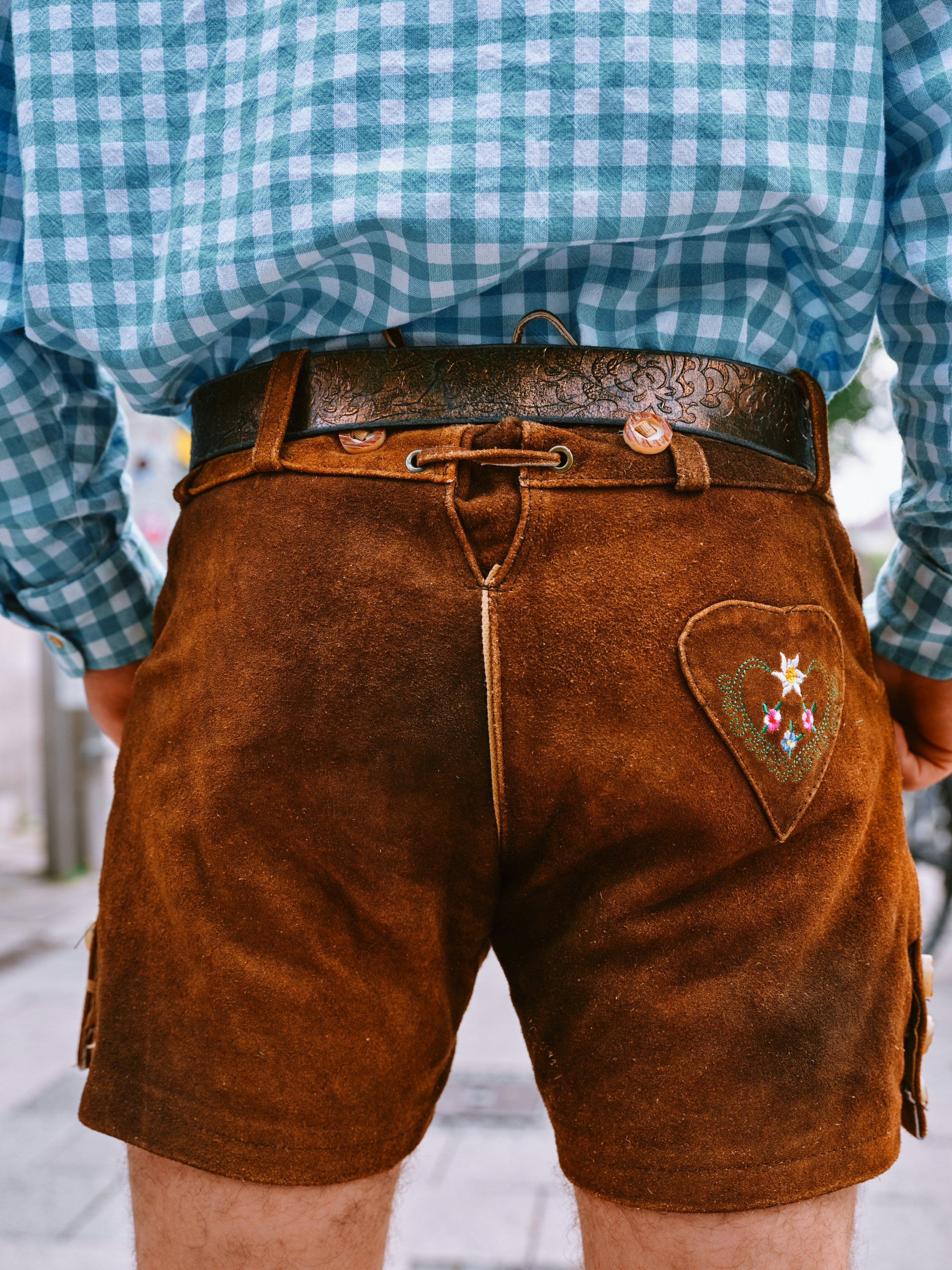
Embroidery: Traditional Bavarian embroidery on the bib (Latz), legs and braces is a sign of quality craftsmanship. High-quality embroidery is dense, even and has clear outlines. On cheap Lederhosen the embroidery is often thin, uneven or even printed rather than stitched.
Seams: Double seams at the waistband, crotch and hem are a must on high-quality Lederhosen. Look at the seams on the inside to see whether they are clean and even. Loose threads or uneven spacing are a bad sign.
Buttons and fastenings: Traditional Lederhosen have horn buttons or metal buttons with an etched motif. Cheap plastic buttons break quickly and look unprofessional. The bib fastening should also be sturdy and work properly.
Braces (Träger): Many Lederhosen come with matching leather braces. Make sure the braces are made of the same leather and the buckles are solidly built. Cheap faux leather braces are easy to spot.
Price Classes at a Glance:
| Price class | Leather | Who it is for |
|---|---|---|
| Budget | Faux leather or thin cowhide | A one-off visit, no regular wear |
| Mid-range | Real cowhide or blended-leather Lederhose | Occasional folk festival visits, solid quality |
| Premium | Wildbock goat leather, deer leather | Regular wear, durability over decades |
| Made to measure | Your choice of options, handmade | Collectors, traditional Tracht families |
For most buyers the mid-range offers the best value for money. You get real leather, solid workmanship and a Lederhose that lasts several years. If you know you will wear Tracht regularly, a premium model is worth the investment.
A Lederhose that does not fit is a wasted investment. The right fit is crucial, both for comfort and for the overall look of the outfit.
The waistband: The waistband should fit firmly without cutting in. You should be able to slide two fingers underneath comfortably, but the trousers must not slip. Lederhosen soften and adapt a little over time, so it is better to buy slightly snug than too loose.
The length: Short Lederhosen usually end at mid-thigh. Kniebundhosen sit just below the knee. The knee band should stay in place without pinching. Traditionally, Kniebundhosen are worn with Wadeln (Tracht socks) that show below the hem.
The crotch: A crotch that is too tight is uncomfortable and turns every movement into a chore. When you try them on, test it: sit down, stand up, lift your legs. The crotch should allow freedom of movement without hanging too loose.
The bib (Latz): The bib (front panel) should lie flat and open and close without any trouble. If the bib sticks out or pulls, the Lederhose is too tight.
We explain how to work out your exact size step by step in our Measuring Your Lederhose Size Guide. There you will also find a size chart with all the relevant body measurements.
Important: Lederhosen often feel a bit stiffer and tighter than you would like at first. That is normal. Real leather softens with wear and adapts to your body shape. After two or three outings the Lederhose fits like a second skin.

The Lederhose alone does not make an outfit. Only with the right companion pieces do you get a coherent Tracht look.
Tracht shirt: The Tracht shirt is the most important companion piece. White shirts go with any Lederhose, while checked shirts in red and white or blue and white are the Bavarian classic. The shirt is always tucked into the trousers. Our Trachtenhemd Guide explains everything about choosing the right one.
Shoes: Traditionally, Haferl shoes are worn with Lederhosen. These are sturdy, low leather shoes with a characteristic seam along the side. With short Lederhosen, Tracht boots or rustic lace-up shoes also work. Trainers or sneakers look out of place.
Wadeln (Tracht socks): A Kniebundhose goes with Wadeln, knee-high Tracht socks made of wool. They should match the colour of the Lederhose and the shirt. Natural white or grey Wadeln are classic. With a short Lederhose you wear shorter Tracht socks or leave your legs bare.
Janker or waistcoat: A Trachtenjanker (loden jacket) or a Tracht waistcoat completes the outfit, especially in cooler temperatures. The Janker should match the Lederhose in colour and style.
Accessories: A Charivari (Tracht jewellery worn on the braces), a leather wallet and a Tracht belt are optional but authentic additions.
For all the details on the perfect folk festival outfit, including tips on combining pieces, read our Volksfest Tracht Guide.
A good Lederhose lasts a lifetime if you look after it properly. The most important rules:
Do not wash it in the washing machine. Real leather must never go in the machine. The combination of water and heat destroys the leather structure and the seams. You can remove small stains with a damp cloth and leather care soap.
Air it out after wearing. After each use, hang the Lederhose on a hanger rather than folding it. Let it air dry, never in direct sunlight or near radiators.
Condition it with leather grease or leather wax. Once a year, especially before the season, you should treat the Lederhose with a suitable leather care product. This keeps the leather supple and protects it from cracking. Pay attention to the specific products for suede and smooth leather.
Store it properly. Outside the season, keep the Lederhose in a linen bag or a garment cover. Not in plastic bags, as the leather needs to breathe. Dry, cool and protected from light is ideal. You will find more tips on storing Tracht in our Guide to Storing Dirndl and Tracht.
The breaking-in process: New Lederhosen are often still stiff. That is not a fault, it is normal. With every wear the leather gets softer and adapts to your figure. Do not speed up the process with heat or moisture, just wear them regularly.
A well-cared-for Lederhose made of real leather is an investment for generations. Many traditional families in Bavaria wear Lederhosen that have been handed down from grandfather to father to son.
If you are looking for a new Dirndl that is easy to care for and high quality, take a look at our store
Discover Lederhosen
Wildbock goat leather is the highest-quality material: soft, breathable and long-lasting. It is more expensive, but the best investment for regular wear. Cowhide is a solid, more affordable alternative. You should only consider faux leather for occasional outings.
The price depends mainly on the leather and the workmanship. Real cowhide with solid workmanship sits in the middle of the range, premium models made of Wildbock last for decades, and very cheap Lederhosen are mostly made of faux leather or very thin cowhide. You will find current prices in our Lederhosen collection.
The short Lederhose (Bundhose) ends above the knee, is airier and is the most popular style. The Kniebundhose ends just below the knee, is more traditional and more versatile for formal occasions. For the Oktoberfest, both are equally suitable.
Real Lederhosen must not go in the washing machine. Treat stains with a damp cloth and leather care soap. Air the Lederhose out after wearing it and rub it with a leather care product once a year.
Measure your waist with a tape measure and compare it with the manufacturer's size chart. If in doubt, choose the smaller size, as leather stretches and becomes looser with wear. Our detailed Measuring Your Lederhose Size Guide explains the process step by step.
Discover Matching Tracht

Stay up to date
Sign up and be the first to find out about new collections, exclusive offers and styling tips for your perfect traditional outfit.


